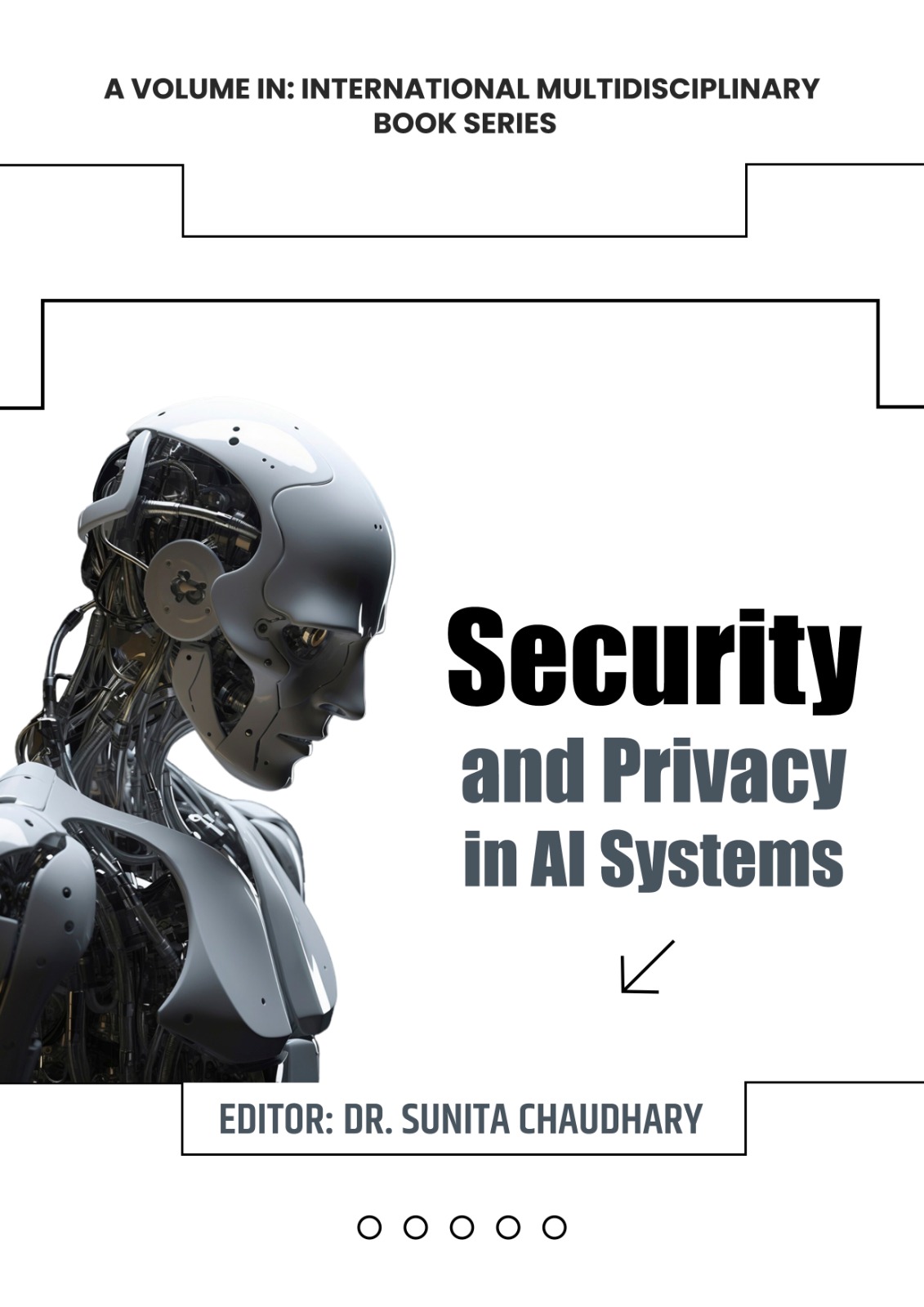
Security and Privacy in AI Systems
DOI:
https://doi.org/10.69889.IMBS-3(1)Subjects/Theme:
Security, Privacy, AI, New Technology, Computer ScienceDescription
The rapid convergence of artificial intelligence, distributed computing, and data-driven technologies has fundamentally transformed the landscape of modern digital ecosystems. From healthcare and financial services to smart cities and industrial control systems, intelligent and interconnected infrastructures are now central to innovation and societal progress. However, this transformation has also introduced complex and evolving security and privacy challenges that demand rigorous research, interdisciplinary collaboration, and forward-looking solutions.
This edited volume, “Security and Privacy in AI Systems,” brings together cutting-edge contributions that explore the vulnerabilities, threats, and defense mechanisms shaping today’s cyber-physical and AI-enabled environments. The chapters in this book collectively highlight the dual nature of technological advancement—where increased capability often coincides with heightened exposure to adversarial risks.
A central theme of this volume is the security of AI-driven and distributed learning systems, particularly in sensitive domains such as healthcare. The exploration of adversarial attacks on federated learning models underscores the risks of data poisoning and model inversion in collaborative environments where data privacy is paramount. Complementing this, the discussion on synthetic data generation reveals emerging concerns related to membership inference and unintended information leakage, emphasizing that even privacy-enhancing techniques can introduce new vulnerabilities.
The book also addresses next-generation cryptographic frameworks designed to secure data in decentralized and privacy-sensitive applications. Contributions on post-quantum cryptography and homomorphic encryption reflect the urgent need to future-proof systems against evolving computational threats while enabling secure data processing. Similarly, secure multi-party computation protocols demonstrate how collaborative analytics can be achieved without compromising the confidentiality of sensitive datasets, particularly in domains such as genomics.
Another critical dimension explored in this volume is the security of modern computing infrastructures, including cloud-native environments, trusted execution environments (TEEs), and industrial control systems. The examination of side-channel vulnerabilities in TEEs provides a microarchitectural perspective on data leakage risks, while the analysis of ransomware propagation in industrial networks highlights the potential consequences of cyberattacks on critical infrastructure. The implementation of zero-trust architectures in multi-cloud Kubernetes environments further reflects the paradigm shift toward identity-centric and continuously verified security models.
In parallel, the book investigates privacy-preserving data analytics in large-scale, real-time systems, such as smart city IoT networks. The application of differential privacy mechanisms illustrates the ongoing challenge of balancing data utility with privacy guarantees in dynamic and heterogeneous environments. Additionally, the use of graph neural networks for insider threat detection demonstrates the growing role of advanced machine learning techniques in behavioral cybersecurity and anomaly detection.
Collectively, the contributions in this volume emphasize that addressing contemporary cybersecurity challenges requires a holistic approach—one that integrates advances in machine learning, cryptography, systems engineering, and data science. The interdisciplinary nature of this work aligns with the goals of international multidisciplinary research, fostering dialogue across domains and encouraging the development of robust, scalable, and privacy-aware solutions.
This book is intended for researchers, practitioners, and policymakers seeking to understand and address the complexities of securing modern AI-driven systems. By presenting both theoretical insights and practical frameworks, it aims to contribute to the ongoing discourse on building resilient, trustworthy, and privacy-preserving digital ecosystems.
We extend our sincere gratitude to all contributing authors for their valuable research and to the reviewers for their thoughtful feedback. We also acknowledge the support of the publishing team in bringing this volume to fruition. It is our hope that this collection will inspire further research and innovation at the intersection of cybersecurity, privacy, and intelligent systems.
CONTENTS
Chapter 1
Adversarial Attacks on Federated Learning Models In Healthcare Data Ecosystems
Soumili Kundu
Chapter 2
Post-Quantum Cryptography for Securing Blockchain-Based Financial Transactions
Soumili Saha
Chapter 3
Side-Channel Vulnerabilities in Trusted Execution Environments (Tees): A Microarchitectural Analysis
Shruti Pramanik
Chapter 4
Security Implications of Synthetic Data Generation: Membership Inference and Model Leakage Risks
Roshmi Paul
Chapter 5
Insider Threat Detection Using Graph Neural Networks on Enterprise Access Logs
Anubhab Sen
Chapter 6
Data Leakage Prevention in Ai-Powered Recommendation Systems Using Homomorphic Encryption
Pinki Oraon
Chapter 7
Differential Privacy Mechanisms for Smart City Iot Data Streams: Utility–Privacy Trade-Offs
Saniya Mondal
Chapter 8
Ransomware Propagation Modeling in Industrial Control Systems (Ics) Networks
Soumadeep Biswas
Chapter 9
Secure Multi-Party Computation Protocols for Privacy Preserving Genomic Data Analysis
Tanusree Mondal
Chapter 10
Zero-Trust Architecture Implementation in Multi-Cloud Kubernetes Environments
Chanda Rani Sen